Two milestones this week, both more fun than expected. The timing feels right, too: the reindustrialization trend finally caught up with me, hardware is accelerating, and the fastest way to understand any of it is to build.
Onshape fundamentals are done. I worked through the “Introduction to CAD” Onshape path. The whole discipline compresses to one loop: sketch, constrain, extrude, assemble.
The lesson that stuck: a sketch should be fully constrained. Change one driving dimension and the entire model updates in lockstep. If it doesn’t, the sketch was underdefined and you were relying on luck to hold the geometry together. That is the same instinct I trust in software, define the part precisely enough that nothing floats, and the thing stays explainable one layer down. CAD turned out less intimidating than expected. As I put it on an earlier X post: it is not so hard, just a very logical way to design physical things.
The other surprise was how much speed hides in the interface. Learning the keyboard shortcuts, and the right-click-drag orbit instead of hunting for the little view cube, turned a slow tool into a fast one. Small thing, but it is the difference between fighting the software and thinking through it.
The bench is live. Hakko iron and stand, helping hands, a silicone mat, a wall of labeled drawers, and a multimeter. Everything within reach, nothing precious. Long journey ahead of me.
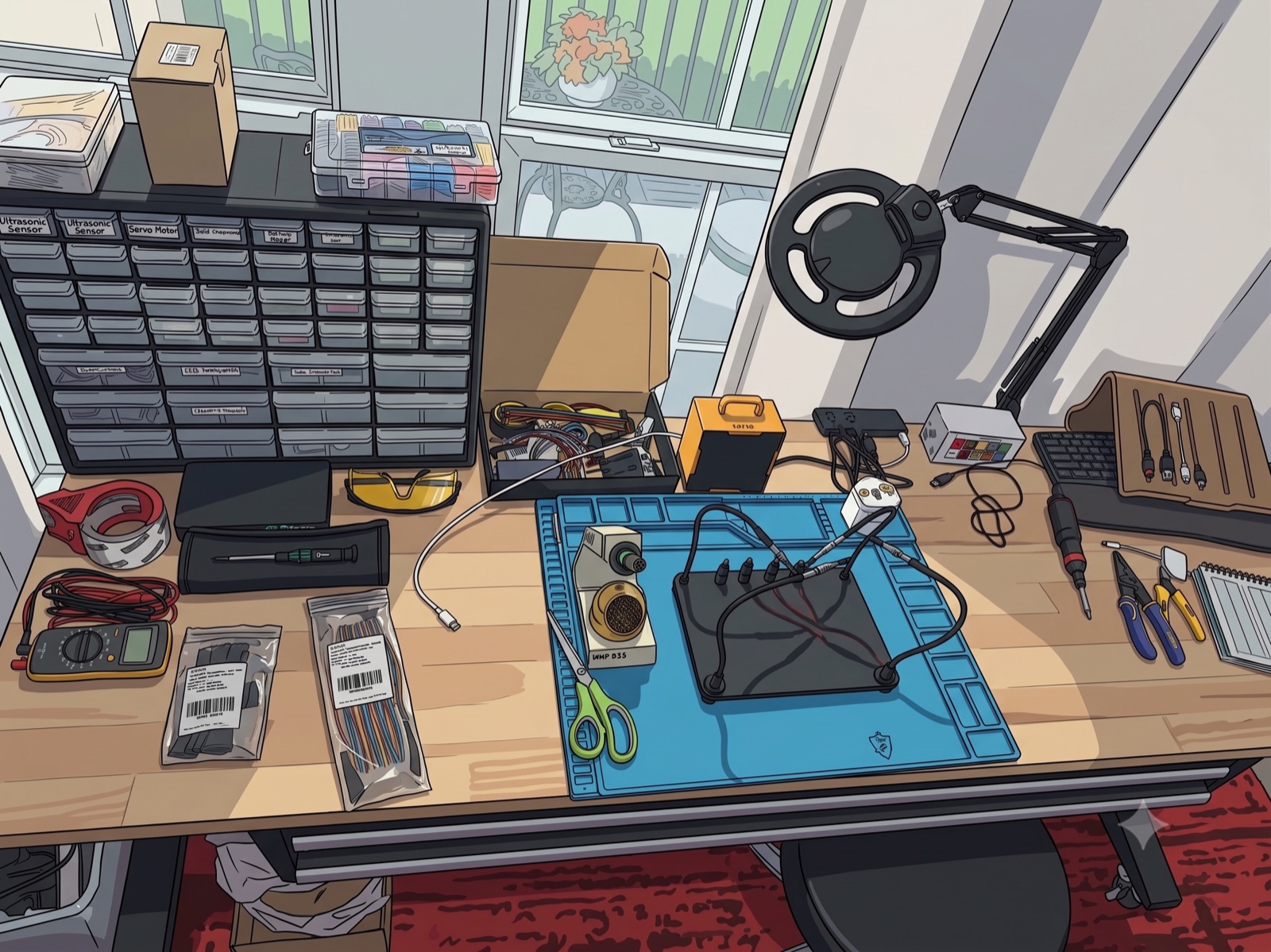
Now the exciting part the Make: Electronics author warns about: burning things on purpose. I’m working through the book, which teaches how to overload an LED, cook a resistor, and short things until I feel the limits instead of reading them off a datasheet. A few components have already given up their smoke, some by design, some by pure newbie error. Both count as learning. Ohm’s law and the other axioms feel less haunting than they did a week ago, though I assume a humbling moment is queued up the minute the experiments get serious.
In software a wrong assumption throws an error. On the bench it smells like burnt plastic.
What I’m seeing out there. While I’m down at the level of single resistors, the top of the field keeps reminding me why this is worth doing. The humanoid robot hands coming out now are a masterclass in combining evolution and engineering, and the gap between that and a beginner shorting an LED is enormous. But it is the same stack, and the only way across it is one well-understood layer at a time. The future is here and accelerating. Better to be building in it than watching it.
Next up: enough soldering reps to trust my joints, then the first circuits that are actually supposed to survive.